
Even a decade after its initial release, the charming pixelated world of Stardew Valley remains a fertile ground for fan theories and deep-seated mysteries. While players have meticulously combed through every tile of the farm, mined every level of the Skull Cavern, and befriended every villager, some enigmas persist, growing more intriguing with time. The game's cozy exterior belies a surprisingly rich and sometimes cryptic lore, with the most compelling puzzles often centered not on ancient artifacts, but on the villagers themselves. From whispered romances to questionable parentage, Pelican Town is a hotbed for speculation, but one theory about a particular resident has stood the test of time, refusing to be neatly solved.
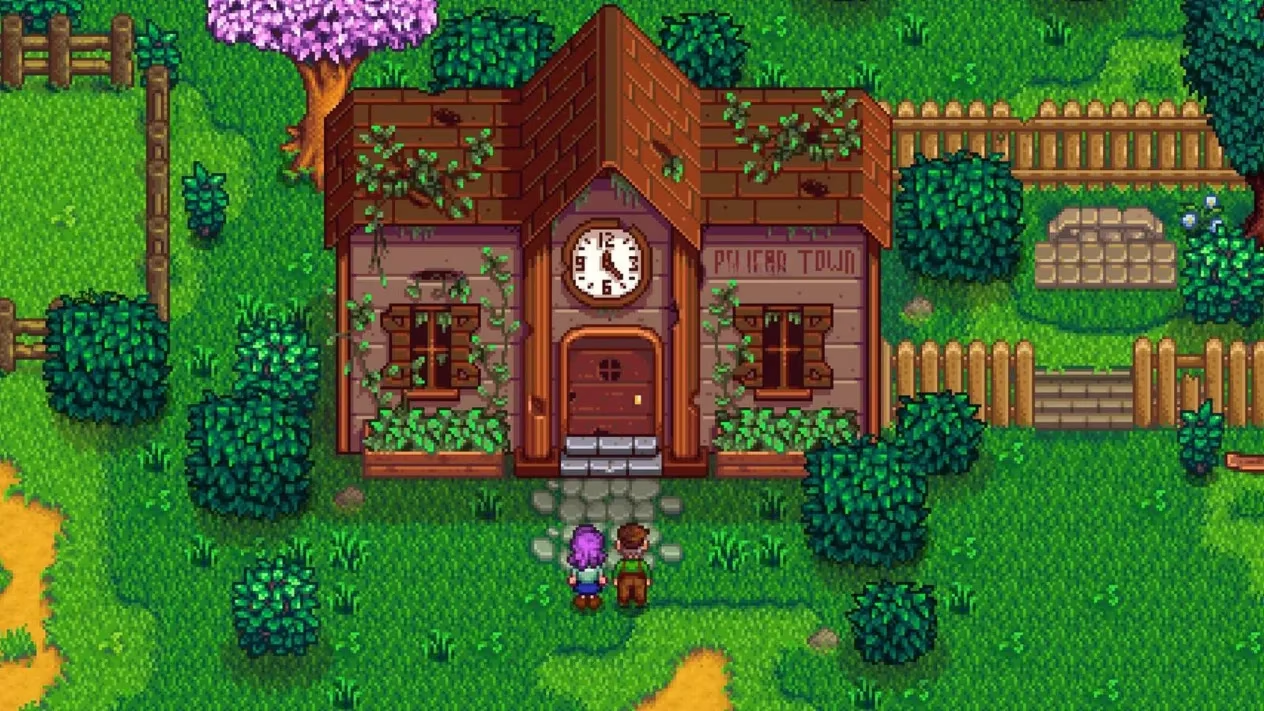
Let's talk about the villagers. 🧐 Not every NPC gets the same depth of story—some, like Clint, desperately need a lore update—but their interactions create a web of potential rumors. You've got Mayor Lewis and his "secret" stash of gold statues and relationship with Marnie, a secret everyone in town seems to know but politely ignores. Then there's the whole saga of Abigail's vibrant purple hair and her possible connection to the reclusive Wizard living in the woods. These threads are fun, but they're mostly human dramas. The theory that truly elevates the mystery to a divine level involves the town's gentle outcast: Linus.
Yes, the man living in a tent by the mountain lake. The theory, circulating since 2016, posits that Linus is not just a humble forager but is, in fact, Yoba, the in-game deity, walking among mortals in disguise. On the surface, it sounds wild. But the more you examine it, the more unsettlingly plausible it becomes. Let's break down the evidence:
-
A Life in Harmony: Linus's entire existence is one of profound connection with nature. He forages, respects the land, and lives a minimalist, nomadic life. This mirrors the attributes of a nature deity far more closely than any other character.
-
Uncanny Knowledge: Linus often displays awareness of Stardew Valley's rare and magical events that other villagers are completely oblivious to. He speaks of the valley's spirits and rhythms with an intimacy that suggests more than just experience—it suggests a fundamental connection.
-
The Wizard Connection: His relationship with the Wizard, Rasmodius, is particularly telling. The Wizard is one of the few characters who acknowledges the arcane and magical underpinnings of the world. That he treats Linus with a degree of familiarity and respect hints that Linus operates on a similar, if not higher, plane of understanding.
-
Visual Symbolism: While not a direct match to any classic depiction, Linus's bearded, robed appearance and generally benevolent demeanor fit the archetype of a wise, hidden spiritual figure. His color scheme, centered on earthy browns and greens, aligns with Yoba's associated natural domain.
Critics might argue that his perspective is simply the result of a life lived outdoors, a deep wisdom born from homelessness and observation. And that's a perfectly valid, grounded interpretation! The beauty of the theory is that nothing in the game definitively refutes it. The developer, ConcernedApe, has masterfully left enough ambiguity for the imagination to run wild. This intentional vagueness adds incredible depth to Linus's character, transforming him from a simple homeless man into a potential cosmic mystery living in a tent.
The world of Stardew Valley is no stranger to the fantastical. You befriend shadow people, fight monsters, and channel elemental magic. Yet, some elements remain stubbornly unexplained, existing in the peripheral vision of the player's experience.
What other secrets linger in the valley's shadows?
-
The Dwarf Wars: The history of the conflict between the Dwarves and the Shadow People (or "Shadow Shaman") is only hinted at through fragmented scrolls. What was the war really about? Who started it? The full history is a gaping hole in the world's lore.
-
The Merperson: On rainy days, a small, green figure can sometimes be seen near the wooden plank on the beach. Interacting does nothing. Is it a merperson? A forest spirit? A simple Easter egg? Its purpose and origin remain one of the game's most charmingly unsolved visual mysteries.
-
The True Nature of the Junimos: These cute, apple-loving spirits fix the Community Center, but where do they come from? Are they native spirits of the valley, creations of the Wizard, or something else entirely?
As we look to the future, with the spiritual successor Haunted Chocolatier on the horizon, one wonders if some of these elusive worldbuilding threads will be picked up. However, mysteries like Linus's true identity are likely destined to remain beautifully unanswered. They are the soul of the game's enduring community—spaces for players to project their own stories and theories. The cutesy, pastoral exterior of Stardew Valley is, in reality, a canvas painted with questions. And perhaps, that's exactly how it should be. The search for answers, the sharing of theories, and the simple act of wondering what if are activities that keep the community center of our collective imagination bustling with activity, even years after the last parsnip has been harvested. 🤔✨
Comments